
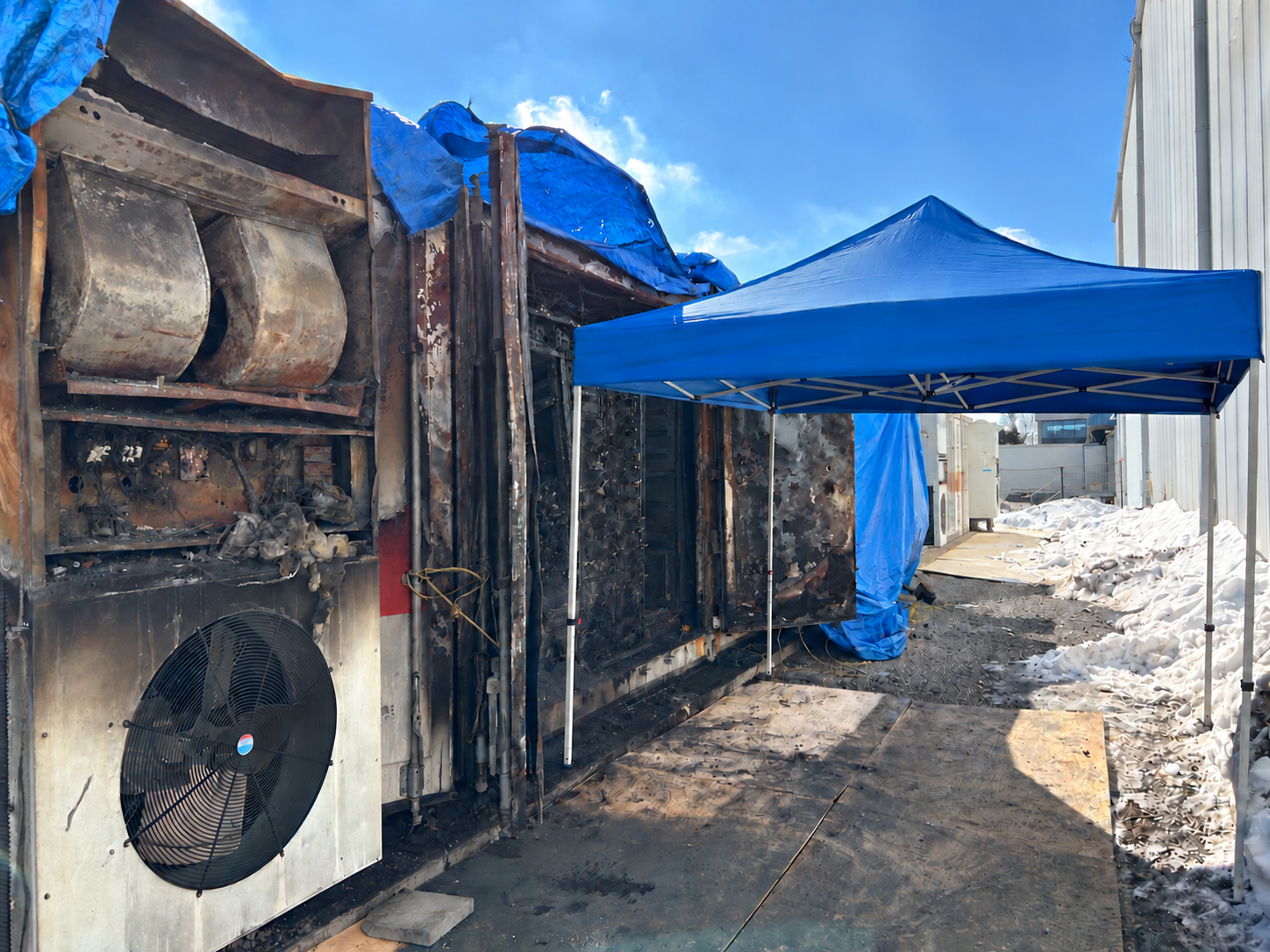
The end of a battery fire is not the end of the project. Once emergency responders have confirmed site stability and authorized access, owners still face a complex recovery effort: preserve material needed for investigation, determine how equipment can be removed, and establish appropriate routes for battery material and debris.
At a Canadian battery energy storage installation, Renewance supported investigation and decommissioning following a thermal event. The work involved both a fire-damaged battery container and an intact container, along with associated electrical equipment. Winter conditions and an adjacent manufacturing facility operating around the clock added practical constraints.
This anonymized project illustrates why recovery needs a coordinated plan—not simply an equipment-removal order.
Two containers, different conditions
The site included two battery containers, each originally equipped with 459 battery modules. One container had been consumed by fire; the other remained intact. That distinction mattered: equipment and material could not be treated as a single, uniform removal stream.
The decommissioning scope also encompassed two power conversion systems, three transformers, one switchgear assembly, a neutral reactor, and site fencing. Those items created electrical, lifting, access, and logistics interfaces beyond the batteries themselves.
For an owner, the scope question is therefore broader than “How do we remove the damaged container?” It is “What must be investigated, retained, disconnected, removed, and documented—and who is responsible for each part?”
Investigation and removal had to work in concert
Renewance's project support started immediately following the event, planning for follow-up investigation, and on-site investigation integrated with decommissioning. This required coordination among investigators, battery specialists, electrical personnel, field technicians, environmental crews, lifting crews, and transportation providers.
Investigation requirements can affect the removal sequence. Selected components or samples may need to be preserved rather than processed with the rest of the material. Equipment access, measurements, photographs, and handling must fit the agreed investigation plan.
The wider lesson is not to rush demolition ahead of those decisions. Owners, insurers, investigators, and other relevant parties need to establish what can be disturbed, what must be retained, and when work can progress.
This case study does not determine the cause of the incident.
Winter weather was part of the work scope
The team faced cold, snow, rain, and wind. Ground conditions also changed as temperatures warmed, creating uneven or unstable working surfaces.
Weather protection and ground conditions were therefore notable planning inputs, not background details. The work needed provisions for outdoor investigation and decommissioning, containment of incident debris, and coordination of equipment and lifting activities around changing site conditions.
The neighboring manufacturing facility continued operating around the clock. That setting reinforced the need to coordinate recovery work with the surrounding site's activities, rather than treating the battery yard as an isolated demolition area.
Battery material needed assessment—not one disposal assumption
One of the important distinctions in the project input is that material from the damaged container was not simply treated as an undifferentiated load for Hazardous Waste Management. Battery material was classified according to its condition, then packaged and processed accordingly.
Fire exposure does not, by itself, establish that every item is suitable for the same handling or disposition route. Battery material, metal structures, and other debris can require different assessments and destinations. Some material may also need to be retained for investigation.
The project team identified recyclable battery material rather than assuming all incident material had to be delivered to a Hazardous Waste Management Facility. No verified recycling percentage or project-wide diversion rate is available for this article, so neither is claimed here.
That distinction matters commercially as well as environmentally: the owner needs a disposition plan based on the material actually present, with appropriate receiving-facility acceptance and supporting records—not a blanket promise of either complete recycling or complete disposal.
Logistics extended beyond the site gate
The supplied project notes identify cross-border logistics, damaged, defective, or recalled battery material handling, and hazardous-waste profiling and disposal of debris as key challenges.
Those activities depend on material condition, classification, packaging, the route, and receiving-facility requirements. A shipment involving more than one jurisdiction needs its own review; a US transport provision should not be assumed to resolve Canadian or cross-border requirements.
For owners and EPCs, that means logistics belongs in the project plan before equipment leaves the site. The recovery scope should define who coordinates classification, packaging, carrier arrangements, receiving facilities, and the documentation needed to follow each material stream.
Define where decommissioning ends and restoration begins
Equipment removal, environmental remediation, and final site restoration are related, but they are not interchangeable milestones.
The project input identifies final restoration as a separate work package, with part of that work to be completed by another party. This article therefore does not claim that Renewance delivered a fully restored open field or completed every above- and below-ground removal activity.
The owner should define those boundaries early: what condition will the decommissioning team leave behind, what environmental assessment or additional work may be required, and who accepts the final restoration scope?
A clear boundary helps avoid a gap between “equipment removed” and “site work complete.”
What owners and project teams can take from this case
The Canadian project highlights five planning priorities:
- Integrate investigation requirements with the equipment-removal sequence.
- Distinguish incident material from intact equipment and assess each material stream.
- Include weather, ground conditions, and adjacent operations in the work plan.
- Resolve packaging, transport, and receiving-facility requirements before shipment.
- Assign responsibility for the handoff from decommissioning to remediation and restoration.
For EPCs and general contractors, these interfaces also matter when removal of an existing system is bundled with replacement construction. Specialist battery decommissioning should be scoped as a coordinated package, with clear investigation, electrical, logistics, and restoration boundaries.
Renewance supports battery owners and project teams with decommissioning planning, investigation support, equipment removal, and battery-material logistics and recycling coordination. If you are planning recovery after an incident—or defining the removal scope within a replacement project—contact Renewance to discuss the site conditions and responsibilities that need to be resolved.