
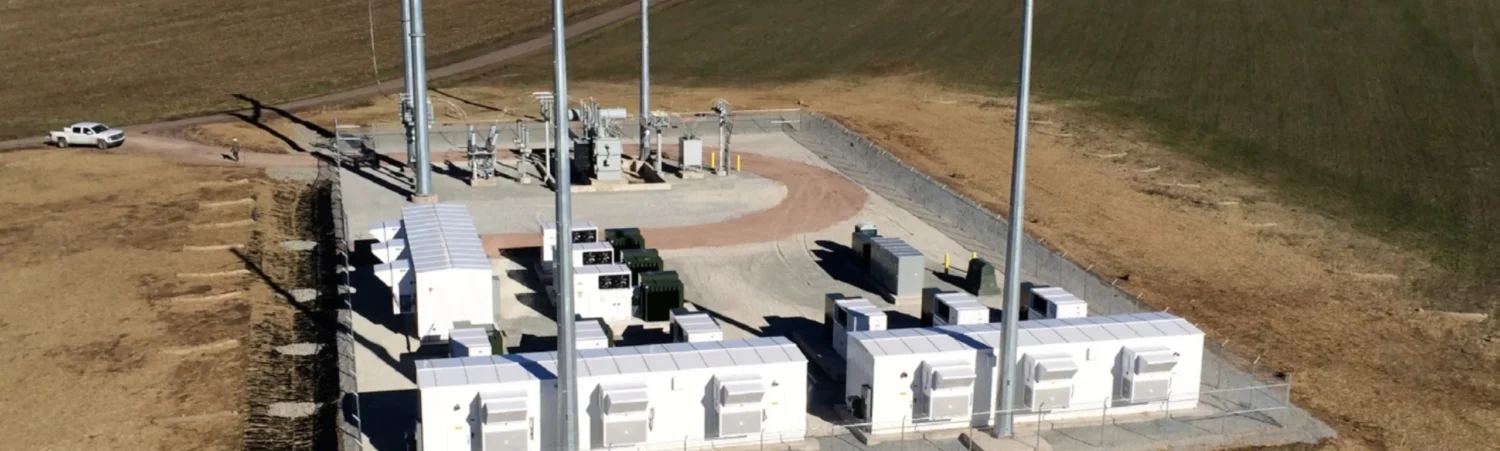
Four battery energy storage sites can share a service provider without sharing the same maintenance plan. In the project information supplied for this story, the sites differ in size, equipment, commercial purpose, and service scope. The lesson is practical: standardize the way work is planned, performed, communicated, and recorded, then tailor the tasks to each asset.
The situation: four sites, four different scopes
The listed sites illustrate a portfolio spanning a small system providing contracted utility or distribution services, a frequency-regulation asset, a site used for peak management and energy arbitrage, and a much larger capacity-focused installation. Preventive and corrective maintenance appear across the examples, but the scope is not identical.
- Site A: Equipment preventive and corrective maintenance plus general site housekeeping.
- Site B: Equipment preventive and corrective maintenance with monitoring included.
- Site C: Equipment preventive and corrective maintenance, monitoring, and advanced analytics.
- Site D: Preventive and corrective maintenance focused on the power conversion system, rather than a full-site service agreement.
These are descriptions of the service scopes, not a claim that all four sites received the same service package or achieved a measured performance improvement. The equipment in scope matters: a provider responsible for one subsystem should not be presented as responsible for the whole facility.
What was done: keep the operating discipline consistent
Start with safety and qualified field work
Routine maintenance and urgent troubleshooting place different demands on a technician, but both require a clear understanding of the equipment, site rules, and work authorization. In the supplied account, Renewance emphasizes technician training, safe field practices, and communication with site personnel. The practical owner question is: who is qualified for this task, and how will the site team know what is happening?
Equipment-maker requirements may also affect who can perform specific work. A maintenance plan should map the relevant contract and warranty provisions to the equipment being serviced, then identify any training or certification that the manufacturer actually requires. Do not assume a qualification on one system applies to every other brand or task.
Link monitoring to action where it is in scope
Two of the submitted examples include monitoring; one also includes advanced analytics. Monitoring can help surface conditions needing investigation early, but it does not replace field diagnosis or repair. Effective handoffs connect an alert or observation to a responsible person, a work order, a site response when needed, and a recorded closeout, i.e. an integrated solution from detection to action.
Where monitoring is not in Renewance's scope, the agreement should still identify who watches the system and how a detected issue reaches the field team. Owners need that responsibility assigned rather than assumed.
Match spares and response planning to the asset
Some faults require a technician; others also require a replacement component that may have a long lead time. Define which critical spares are held, who owns them, and how they reach the site. Align the escalation contacts and response plan with the service scope and the asset's operating role. An equipment-only maintenance agreement is not the same as a multi-year, full-site battery and solar service agreement.
What should be documented
Across different sites, a common operating model can use the same recordkeeping discipline while documenting different work. For each asset, owners and service providers should agree on:
- The equipment in scope, planned tasks, exclusions, and site access rules.
- Required technician qualifications and any manufacturer-specific procedures.
- Monitoring ownership, escalation paths, and communication during field work.
- Spare-parts ownership, availability, and replacement workflow.
- Maintenance findings, corrective work orders, parts used, tests, and closeout evidence.
These records help the next technician understand the asset's history and give the owner a clearer basis for managing warranty obligations. Whether a given document supports a specific warranty or performance claim depends on the actual contract and manufacturer requirements.
The result: a repeatable framework, not a universal package
The submitted material supports a service-design lesson, not a quantified uptime or cost-savings result: keep safety, qualifications, communication, and documentation consistent while tailoring maintenance and technology to each site. Renewance describes its offerings as spanning focused preventive maintenance on a particular equipment type through broader, multi-year, site-level service scopes. What belongs in an individual agreement must be tailored to site-specific scope.
For owners comparing service plans across a mixed portfolio, that distinction is the takeaway. A shared framework makes responsibilities visible; a site-specific scope makes those responsibilities executable.
Questions to ask before signing a multi-site service agreement
- Which equipment is in scope at each site, and what is explicitly excluded?
- Who is qualified to work on each manufacturer’s equipment, and how is that verified?
- Who monitors alarms, dispatches field personnel, and communicates with the site?
- Which spares are available, and what happens when a part is not on hand?
- What evidence will be captured after routine maintenance and corrective work?
If you are defining a service model for battery storage sites with different operating needs, Renewance can help map the scope, responsibilities, and documentation before work begins. Contact Renewance to discuss your portfolio.
Frequently asked questions
Should every BESS site use the same maintenance contract?
No. A consistent safety, communications, and documentation framework can be shared, but the equipment covered, monitoring responsibilities, response arrangements, and spares need to reflect each site's asset and agreement.
Does remote monitoring replace onsite service?
No, it complements onsite service. Where included and technically configured, monitoring can help identify conditions to investigate early for qualified personnel to diagnose, perform, and document the work appropriate to the issue. Effective handoffs connect an alert or observation to a responsible person, a work order, a site response when needed, and a recorded closeout, i.e. an integrated solution from detection to action.