
When a battery leaves a vehicle, depot, or operating site for service, the owner still needs to know where it is, what has been found, and what happens next. For a fleet, manufacturer, or dealer coordinating multiple assets, that information needs to stay connected to the individual battery—not scattered across separate status updates and service documents.
RenewanceConnect provides that connection. Its ticketing system supports service requests, while asset-location mapping, service status, and maintenance and repair history help customers follow their batteries through the lifecycle. Behind that visibility is Renewance’s workshop capability: inspecting units, investigating faults, carrying out applicable repairs, and documenting the checks that follow.
The combination matters because battery service is not one fixed sequence. Different battery designs, faults, customer requirements, and intended destinations call for different work. RenewanceConnect provides visibility into that work without treating every battery as the same repair job.
On this page
- A service request connected to the asset and its history
- A consistent record—not an identical repair path
- Example: tracing a pack fault through repair and validation
- Example: preparing fleet batteries for a different destination
- Documented findings support the customer’s decision
- Discuss your battery service and visibility requirements
A service request connected to the asset and its history
Consider a fleet operation in which a vehicle returns to a depot and its battery is swapped out. A service ticket can initiate the next step, whether the customer requests collection or arranges delivery to Renewance.
That request is the start of a service record, not just a shipping instruction. RenewanceConnect allows customers to follow progress, access uploaded observations and test results, and refer to the asset’s maintenance and repair history. Geographic asset mapping adds location visibility alongside lifecycle and service status.
Where a service arrangement involves a fleet, an OEM, and a dealer, multiparty access supports coordination among the participating organizations. The practical value is keeping the asset, its service activity, and the information needed for the next decision connected.
A location or a milestone alone cannot explain a repair. The supporting records are what make that visibility useful: photographs of the received condition, diagnostic observations, test results, and the work performed.
A consistent record—not an identical repair path
Renewance’s service milestones can include receipt, inspection and repair, service completion, shipment, and customer receipt. The technical work between those milestones depends on the battery and the issue being investigated.
An incoming inspection may establish enclosure condition, connector damage, missing protection, or signs of leakage. Further investigation can involve electrical measurements, software diagnostics, insulation resistance, airtightness, or capacity testing. Repairs can range from replacing individual components to addressing control and communication faults, with balancing, voltage adjustment, and other activities selected for the applicable scope.
These capabilities are not a checklist to apply indiscriminately. Their value is in identifying the fault, choosing the appropriate intervention, and checking the result. Two examples show how that depth translates into different service paths.
Example: tracing a pack fault through repair and validation
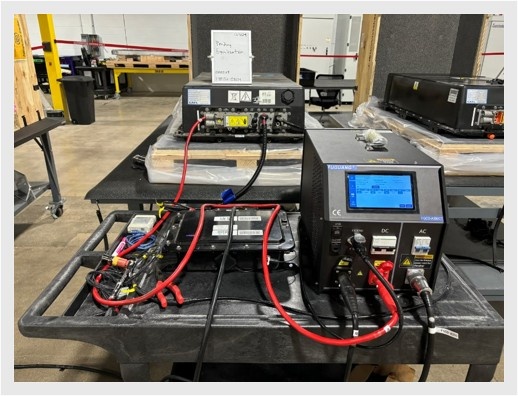
For one customer’s battery pack at Renewance’s Elmhurst RenewanceCenter, intake involved visual inspection, a battery management system connection, a short data log, cell-voltage measurements, and a heater check.
The findings went beyond visible damage. Technicians recorded low cell voltages in two cassettes, an approximately 3 V imbalance, contactors that were not responding, an intermittent 24 V supply, and outdated firmware.
Diagnosis identified faulty monitoring boards and a battery disconnect unit start-relay circuit that was not powering the 24 V supply. The work addressed the identified faults through monitoring-board replacement, a battery disconnect unit enclosure replacement, and a firmware update.
Validation included heater testing across all 14 boards, a discharge/charge cycle, cell balancing, and outgoing inspection. Component serial traceability formed part of the service record. The reported imbalance reduced from 3,069 mV to 67 mV, and the pack passed the documented checks.
That result illustrates more than a completed repair. It connects the initial symptoms to the diagnosed faults, the intervention, and the subsequent checks. The figures describe this individual case, not a universal acceptance limit or a guarantee of the same outcome for another battery.
Example: preparing fleet batteries for a different destination
An EV bus fleet battery service workflow illustrates a different requirement. The work includes intake, CAN data review, internal resistance and air-leak testing, cell balancing, and charge-level maintenance. Voltage is matched to the destination vehicle before the battery moves into remanufactured stock.
Here, the service question is not simply whether a component can be replaced. It also concerns the battery’s condition and preparation for its intended destination. Keeping the unit’s identity, findings, work history, status, and location traceable is particularly valuable when batteries move between depots, service facilities, and stock.
The two examples should not be read as one standard sequence. They show why workshop expertise and flexible service visibility need to work together.
Documented findings support the customer’s decision
Not every test failure leads to the same disposition. Renewance provides a recommendation on whether a battery can be repaired; the customer decides whether to authorize repair, recycle the unit, or request its return unrepaired.
RenewanceConnect supports that decision with accessible progress and service records. It does not replace the technical investigation or the customer’s authorization. It connects them, helping the customer understand what has been found and what the proposed next step involves.
For organizations managing batteries across locations and service partners, that is the wider value: repair expertise backed by a traceable record, rather than a repair status with no explanation behind it.
Discuss your battery service and visibility requirements
Contact Renewance to discuss your battery assets, service requirements, and how RenewanceConnect can support visibility across the work—from the initial request through the next lifecycle decision.